
AI in School Should Be Assessed, Not Pretended Away
The future of AI in secondary education should not be a choice between banning tools and surrendering learning to automation. Schools need to protect attention, reading and handwriting while redesigning assessment around real understanding.
Sweden's decision to bring more books, handwriting and low-screen learning back into school is not a nostalgic detail. It is a useful signal.
The point is not that digital tools are bad. The point is that different interfaces shape different forms of attention.
Paper, handwriting and printed books still matter because learning is not only information access. Learning is attention, memory, interpretation, repetition, explanation and personal ownership of knowledge.
Research on reading from paper compared with screens is nuanced, but several reviews and experiments point in the same direction: paper often has an advantage for comprehension, metacognition and sustained reading, especially when the task is cognitively dense. Handwriting also remains important for literacy development because it connects motor action, perception and memory.
That is a strong argument for protecting books, notebooks and handwriting in school.
It is not an argument for pretending artificial intelligence does not exist.
The Wrong Question: How Do We Stop Students From Using AI?
Many teachers are now facing a very practical problem. A homework assignment can be generated by AI. A summary can be produced in seconds. A translation can be completed before the student has struggled with the sentence.
It is understandable that schools react by asking how to block, detect or prohibit the tool.
But that is not the most important question.
The better question is: what kind of learning should remain visible even when AI is available?
If the only thing a school can evaluate is the final written output, then AI exposes a weakness that was already there. The assessment was too close to production and too far from understanding.
A student can ask an AI system to translate a Latin passage. But the real educational question is whether the student can explain why the translation works, identify the structure of the sentence, discuss alternatives and answer follow-up questions.
In that sense, AI does not remove the need for assessment. It makes better assessment more urgent.
AI Should Be a Tutor, Not a Substitute Mind
I do not think the right path is to teach students as if they will live without artificial intelligence.
They will not. Universities, companies and public institutions are already changing around AI. The issue is whether students learn to use it as an aid to reasoning or as a replacement for reasoning.
There is a deep difference between these two uses. In one case, the student asks AI to do the homework and stops there. In the other, the student uses AI to surface difficult passages, request explanations, compare interpretations, test understanding and then make the knowledge their own.
The second use is educational. The first use is outsourcing.
This distinction should be at the center of AI education. The objective is not to preserve a world without AI. The objective is to make sure AI remains a support for real intelligence, not a replacement for it.
Assessment Has to Move Closer to Understanding
Oral assessment is still powerful for a simple reason: the student has to be present with their own understanding.
A written assignment can be delegated. A live explanation is harder to fake. A teacher can ask a follow-up question, change the angle, test a connection, ask for an example, or invite the student to reconstruct a passage step by step.
This does not mean every school should return to only traditional oral exams. It means that assessment should become more diagnostic, more interactive and more personalized.
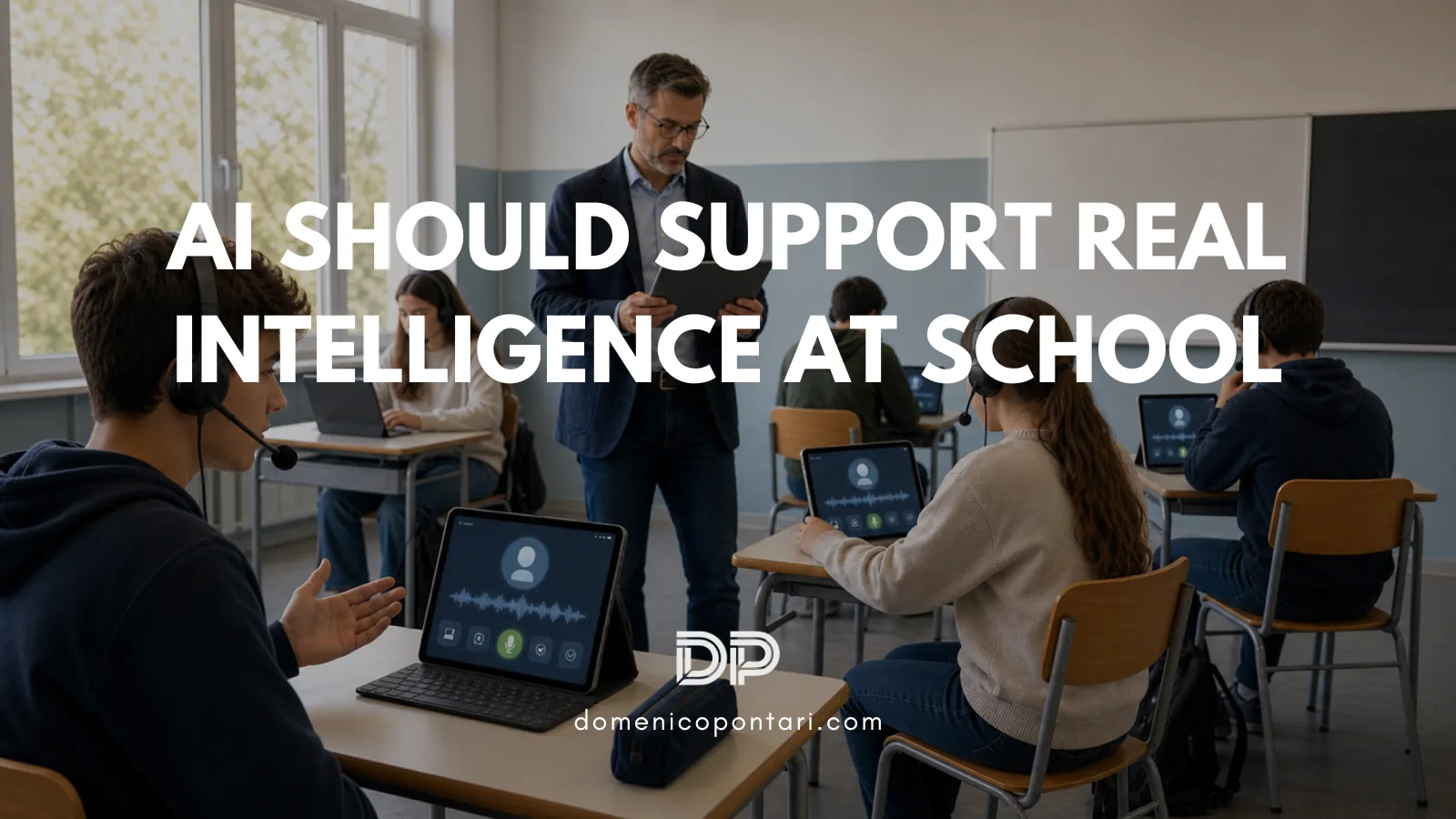
AI can help here too. A properly designed conversational agent could support teachers by running structured oral checks, asking adaptive questions and producing a trace of which concepts a student can explain. In a classroom of twenty students, this could make simultaneous formative assessment possible in ways that are difficult for one teacher alone.
This should not replace the teacher. It should extend the teacher. The teacher remains responsible for judgment, context, fairness, pedagogy and final evaluation. The conversational agent becomes an assessment assistant, not an educational authority.
This is similar to the broader challenge of organizational adoption: advanced technologies create value only when people, processes and governance evolve around them.
The Missing Layer Is Teacher Training
Schools often focus on what students should or should not do with AI. That is necessary, but incomplete.
Teachers also need training. They need to understand what AI can generate, where it fails, how students may misuse it, how it can be used for explanation, and how assessment can be redesigned around understanding.
Without teacher capability, AI governance becomes a list of rules. With teacher capability, it can become a better learning system.
This is where technical and executive training connects directly to education. AI adoption is not solved by access to tools. It is solved by building the internal capability to use, question, evaluate and govern those tools.
The same principle applies in companies, hospitals, universities and schools. Technology becomes useful when the organization learns how to absorb it.
A Practical Model for AI in Secondary Education
A more balanced model for schools would combine four elements.
- Protect low-screen learning.
Keep books, notebooks, handwriting and focused reading as central learning practices, especially when the objective is memory, comprehension and deep attention. - Teach AI as a study method.
Show students how to use AI to ask for explanations, compare reasoning paths, identify weak points and verify understanding, not only to produce an answer. - Redesign assessment around explanation.
Use oral checks, adaptive questions, in-class reasoning, annotated work and personal reflection to evaluate whether knowledge has been internalized. - Train teachers before scaling tools.
Give educators practical training on AI capabilities, risks, classroom workflows, assessment design and governance.
Why This Matters Beyond School
The debate about AI in school is a preview of a much larger problem. Every organization is asking a version of the same question: how do we adopt a technology that can produce work without letting it erode competence?
The answer is not prohibition. The answer is capability building.
Schools have a particularly important role because they train the habits that will later enter universities, companies and public institutions. If students learn that AI is a way to avoid thinking, organizations will inherit weaker judgment. If students learn that AI is a way to interrogate, explain, practice and verify, society receives stronger learners.
That is why the educational response to AI should be demanding, not defensive.
Keep paper where paper helps. Keep handwriting where handwriting helps. Keep teachers at the center. Then use AI to make learning more personal, more visible and more accountable.
Evidence And Context
The Swedish debate has been covered internationally and in Italy, including by Sky TG24 and AP News. For the learning side, Virginia Clinton's systematic review on paper versus screens, research by Anne Mangen and colleagues on screen reading, and newer work on handwriting and literacy all support a careful conclusion: digital tools can be useful, but they should not replace the practices that build attention, comprehension and ownership of knowledge.
Read more ideas on AI adoption and capability building.
If your school or organization is trying to govern AI use, the first step is teacher capability, not only student restriction.
Discuss AI training for educators